
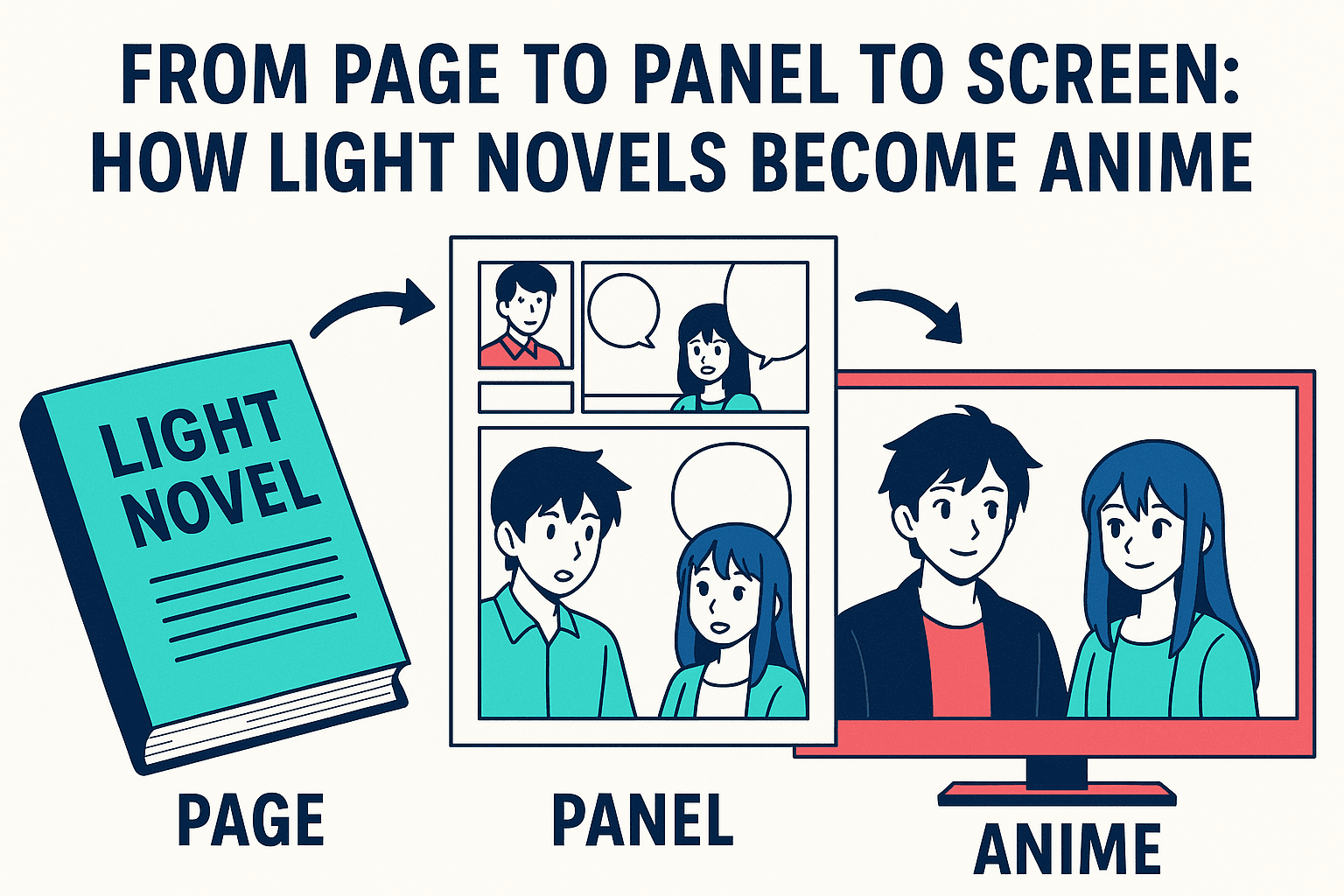

Tracing the journey of your favourite stories from text to TV.
Light novel fans are living in a golden age of adaptations.
Every season, more and more anime are being announced with that magic phrase attached: “based on the light novel.” But what actually happens between a volume dropping in Japan and a full anime season landing on your watchlist?
In this post, we’ll walk through the typical life cycle of a light novel adaptation—from niche book on a shelf to trending anime on your timeline.
Step 1: The light novel finds its audience
Everything starts with the books.
A new light novel launches—sometimes via a publisher’s label, sometimes as a web novel that gets picked up and “polished” into print. The early volumes do the heavy lifting:
- Establishing the premise and world
- Introducing the main cast
- Proving there’s enough story to sustain a series
If the concept resonates, you’ll see:
- Increasing print runs
- Volume reprints
- Rising positions on sales charts
- Growing online fan activity (art, discussion, fan translations of news, etc.)
This phase is often invisible to overseas fans, but it’s where studios and production committees start paying attention.
Step 2: The manga adaptation test
A very common next step: the manga adaptation.
Turning a light novel into a manga serves a few purposes:
- Wider reach – Manga magazines and digital platforms can introduce the story to audiences who never touch light novels.
- Visual proof of concept – Editors and potential anime staff can see how the story might “feel” in a fully visual medium.
- IP growth – Now there are multiple entry points to the same world: novel, manga, and maybe even side stories.
For fans, this is usually the point where the series stops being a quiet cult favorite and becomes “something people talk about.”
Step 3: The adaptation decision
Once a light novel + manga combo shows strong performance, the conversation shifts from “Is this series good?” to “How far can this IP go?”
That’s where production committees come in—groups made up of:
- The publisher
- An animation studio
- Music labels
- Distributors and streaming platforms
- Sometimes game companies or merch manufacturers
Together, they decide:
- Is there enough content for one or more anime seasons?
- Does the premise stand out in the current market?
- Can we sell Blu-rays, merch, and maybe even a mobile game?
When the math checks out, you get what every fan waits for: an anime announcement.
Step 4: Adapting the story (a.k.a. “What did they cut?”)
Once a studio is attached, the creative challenge begins.
Light novels are dense with:
- Inner monologue
- Worldbuilding exposition
- Side conversations
- Minor character details
Anime, on the other hand, runs on strict time constraints. A single cour (12–13 episodes) can only cover so many pages of text. So the staff has to:
- Decide which volumes to cover in a season
- Choose which scenes to condense, move, or cut
- Translate internal thoughts into visual storytelling and dialogue
- Make fights, setpieces, and emotional beats land in motion
This is why LN readers often say the famous line: “The anime was good, but you should still read the novels.”
They’re not gatekeeping. The medium just forces choices.
Step 5: Feedback loop: Adaptation → sales → future seasons
When the anime finally airs, everything loops back to where it started: the light novel.
If the adaptation hits, you’ll usually see:
- Spikes in light novel and manga sales
- Reprints of older volumes
- New licensing deals overseas
- More fan content and social buzz
Those numbers matter. They’re a signal to the production committee that:
- There’s long-term demand
- A second (or third) season might be viable
- Spin-offs, games, or movies have an audience
From a fan’s perspective, buying the original light novels is one of the most direct ways to “vote” for more of the anime you love.
Why some adaptations feel rushed (and others feel perfect)
Not all light novel anime are created equal. Some feel lovingly crafted; others feel like speedruns of your favorite arcs.
That usually comes down to:
- Episode count vs. volume count
3 volumes in 12 episodes? That’s comfortable. 6–8 volumes in 12 episodes? Expect pain. - Series goals
Is the adaptation a genuine attempt to tell the full story, or mainly a promotional push for the books? - Staff passion and constraints
Directors, scriptwriters, and storyboard artists all bring their own tastes—and they’re all operating under harsh production realities.
When everything lines up, you get adaptations that can stand proudly next to (or even above) their source material. When it doesn’t… well, that’s why LN fans keep saying “read the books.”
Why this matters for fans
Understanding this pipeline changes how you experience LN anime:
- You recognize when a season is clearly a “read the novels” marketing push
- You can guess where to jump into the light novels after a season ends
- You appreciate just how much work goes into translating text into animation
And most importantly: you start seeing light novels not just as “source material,” but as a full-fledged medium worth following on its own.
Closing thoughts
Every time a light novel becomes an anime, you’re seeing the result of years of storytelling, fan support, and behind-the-scenes decisions.
So the next time a new season drops with “based on the light novel” in the description, you’ll know exactly how much had to go right to bring it from page to panel to screen.
And if you fall in love with that world? The novels are waiting to show you the rest.